Modern businesses waste hundreds of hours every month on repetitive manual work. From answering customer inquiries to managing spreadsheets, scheduling meetings, sending follow-ups, and updating systems, many daily business tasks consume valuable time that could be spent on growth.
The good news is that automation is no longer limited to large corporations with expensive software teams.
Today, businesses of all sizes can automate major parts of their operations using AI tools, no-code systems, and workflow automation platforms.
At AZ Konnect, one of the most common questions we hear from business owners is:
The answer is: far more than most people realize.
In this guide, we’ll break down the most common business tasks that can be automated, how automation works, and how businesses use AI-powered systems to save time, improve efficiency, and scale operations faster.
Why Businesses Are Turning to Automation
As businesses grow, manual work becomes one of the biggest bottlenecks.
Teams spend hours every week handling repetitive operational tasks that slow down productivity and create inefficiencies.
Automation helps businesses:
- Save time
- Reduce repetitive manual work
- Improve operational efficiency
- Increase productivity
- Reduce human error
- Improve customer response times
- Scale operations more efficiently
Instead of constantly handling repetitive tasks manually, businesses can create systems that work automatically in the background.
This allows teams to focus on strategy, sales, customer experience, and growth rather than repetitive admin work.
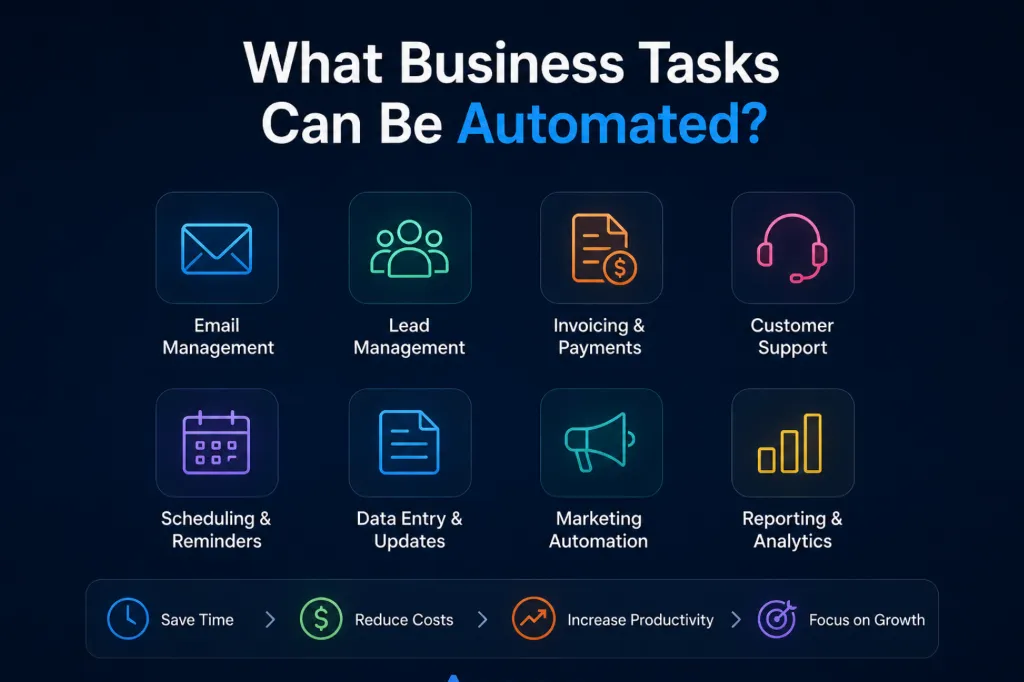
What Business Tasks Can Be Automated?
The reality is that almost every business has repetitive workflows that can be partially or fully automated.
Below are some of the most common automation opportunities.
Lead Management & Follow-Ups
Many businesses lose leads simply because follow-ups are delayed or inconsistent.
Automation can help businesses:
- Instantly respond to inquiries
- Send automated follow-up emails
- Route leads to sales teams
- Schedule consultations automatically
- Track lead status
- Send reminders and notifications
For example:
When a customer fills out a website form, the system can automatically:
- Send a confirmation email
- Notify the sales team
- Add the lead to a CRM
- Schedule follow-up tasks
- Trigger automated nurturing emails
All without manual input.
Customer Support Automation
Businesses spend significant time answering repetitive customer questions.
AI-powered automation systems can help handle:
- FAQs
- Appointment scheduling
- Order status updates
- Customer onboarding
- Support ticket routing
- Live chat responses
AI chatbots and automated support systems allow businesses to provide faster responses while reducing support workload.
This is especially useful for:
- service businesses
- e-commerce brands
- agencies
- healthcare clinics
- home service companies
Appointment Booking & Scheduling
Scheduling meetings manually wastes time and creates unnecessary back-and-forth communication.
Automation systems can:
- Handle appointment bookings
- Sync calendars automatically
- Send confirmations
- Deliver reminders
- Prevent double-bookings
- Manage cancellations and rescheduling
This improves both customer experience and internal efficiency.
Email Marketing Automation
Email marketing becomes far more effective when automation is involved.
Businesses can automate:
- welcome emails
- abandoned cart emails
- follow-up sequences
- lead nurturing campaigns
- promotional campaigns
- customer retention emails
Instead of manually sending emails every day, businesses can build systems that automatically communicate with customers based on behavior and actions.
Social Media Management
Content creation still requires creativity, but many social media workflows can be automated.
Businesses can automate:
- content scheduling
- publishing workflows
- reporting
- engagement tracking
- lead collection
- DM responses
- analytics monitoring
This helps brands stay consistent online without manually posting every day like exhausted raccoons trying to survive another algorithm update. Humanity truly invented machines just to feed other machines content 24/7.
Sales Pipeline Automation
Sales teams often waste time updating spreadsheets and moving leads manually between stages.
Automation can streamline:
- CRM updates
- lead scoring
- proposal delivery
- sales notifications
- pipeline tracking
- follow-up reminders
- onboarding workflows
This creates faster and more organized sales operations.
Invoice & Payment Automation
Financial workflows can also be automated to reduce admin work.
Businesses can automate:
- invoice generation
- payment reminders
- recurring billing
- receipt generation
- bookkeeping workflows
- expense tracking
Automation improves accuracy while reducing operational delays.
Internal Team Workflows
Businesses can also automate internal operations such as:
- task assignments
- employee onboarding
- approval systems
- reporting workflows
- project management notifications
- document organization
These systems improve communication and operational efficiency across teams.
Can Small Businesses Use Automation?
Absolutely.
One of the biggest misconceptions is that automation is only for large companies.
Modern no-code and AI automation tools allow small businesses to automate operations without needing complex development teams.
Even simple automations can create major improvements in:
- productivity
- customer response times
- lead generation
- organization
- operational efficiency
Many businesses start with just one or two automations and expand over time.
Do You Need Coding Skills?
No.
Modern automation platforms allow businesses to create systems using visual workflows and no-code tools.
This means businesses can automate:
- forms
- emails
- lead flows
- notifications
- customer journeys
- CRM systems
- reporting workflows
without traditional software development.
Of course, more advanced systems can involve custom AI integrations and backend development, which is where professional automation agencies help build scalable infrastructure.
Signs Your Business Needs Automation
Your business likely needs automation if:
- your team repeats the same tasks daily
- leads are being missed
- customer responses are slow
- manual work is overwhelming operations
- workflows are disorganized
- scaling feels chaotic
- employees spend hours on admin work
- communication is inconsistent
These are usually signs that systems need optimization.
The Real Goal of Automation
Automation is not about replacing people.
It’s about removing repetitive operational friction so teams can focus on higher-value work.
The best automation systems help businesses:
- operate faster
- scale more efficiently
- improve customer experience
- reduce operational stress
- increase profitability
When implemented correctly, automation becomes a long-term growth asset rather than just another software tool.
Final Thoughts
Most businesses are far more automatable than they realize.
From customer support and lead generation to scheduling, sales workflows, email marketing, and internal operations, automation can dramatically improve how a business functions every day.
The businesses growing fastest today are often the ones building smarter systems behind the scenes.
At AZ Konnect, we help businesses identify repetitive operational bottlenecks and build AI-powered automation systems that save time, improve efficiency, and support scalable growth.