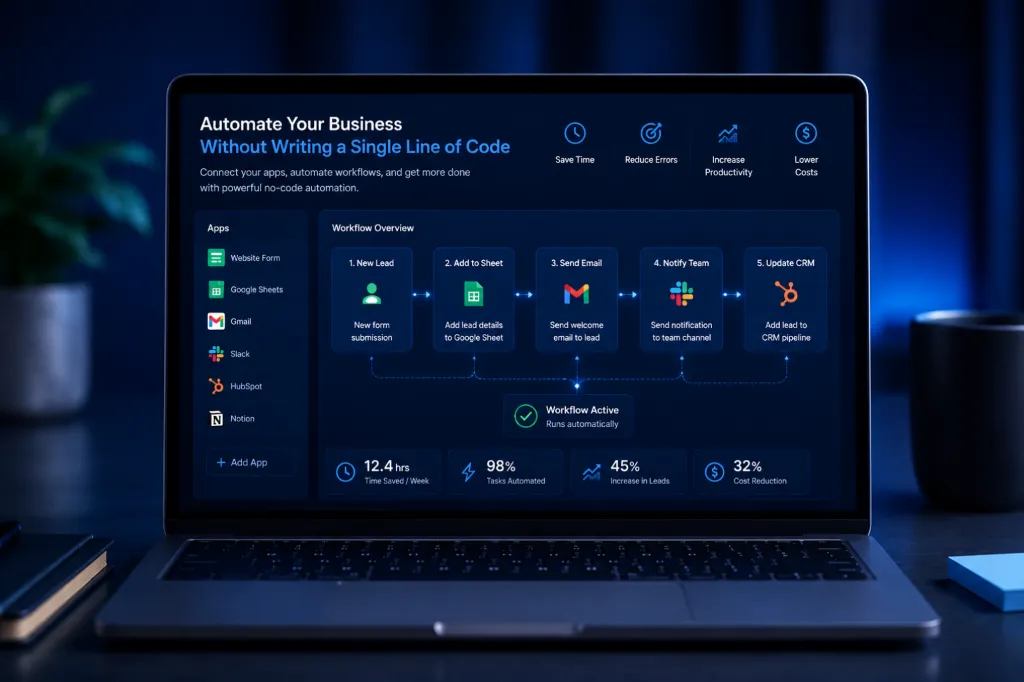
Running a business often means dealing with repetitive daily tasks that consume time, reduce productivity, and slow growth. Many business owners spend hours manually responding to inquiries, organizing leads, updating spreadsheets, sending follow-ups, scheduling appointments, and managing internal workflows.
The biggest problem is that most non-technical founders assume automation requires coding knowledge, expensive software development, or a large technical team.
The reality is very different.
Today, businesses can automate a large percentage of repetitive work using modern no-code automation systems, AI tools, and workflow platforms — without writing a single line of code.
Why Repetitive Tasks Hurt Business Growth
Manual tasks may seem manageable at first, but as a business grows, they quickly become operational bottlenecks.
- Manual lead follow-ups
- CRM updates
- Appointment scheduling
- Email replies
- Social posting
- Reporting
- Internal notifications
- Onboarding workflows
These tasks reduce efficiency and prevent business owners from focusing on higher-value activities like sales, strategy, customer relationships, and growth.
How No-Code Automation Works
No-code automation platforms allow businesses to connect apps, automate workflows, and build systems visually without programming.
These tools work by creating automated triggers and actions.
- A customer submits a website form
- The system automatically sends a confirmation email
- The lead is added to a CRM
- A notification is sent to the sales team
- A follow-up sequence starts automatically
Benefits of Business Automation Without Coding
Businesses that implement automation systems often experience major improvements in efficiency and scalability.
- Reduced manual work
- Faster operations
- Improved customer experience
- Scalable workflows
- Increased productivity
- Fewer human errors
Popular No-Code Automation Tools
- Zapier
- Make.com
- HubSpot
- Airtable
- Notion
- Calendly
- Slack automation
- AI chatbots
What Businesses Can Automate
Lead Generation Automation
Auto-responding to inquiries, CRM lead capture, Lead qualification workflows, Follow-up email sequences.
Marketing Automation
Social media scheduling, Email campaigns, Retargeting workflows, Customer segmentation.
Operations Automation
Task assignments, Internal notifications, Reporting systems, Workflow approvals.
Customer Service Automation
AI chatbots, FAQ systems, Support ticket routing, Appointment reminders.
Sales Automation
Meeting summaries, Sales assistance, Workflow recommendations.
AI Automation for Modern Businesses
AI has made automation even more powerful. Businesses can now automate AI customer support, AI lead qualification, AI workflow systems, AI content generation, AI summaries, and AI operational systems. AI-powered systems help businesses improve speed, consistency, and scalability without increasing operational complexity.
Why Most Businesses Fail at Automation
Many businesses attempt automation but fail because they automate broken processes, use too many disconnected tools, lack workflow planning, create overly complex systems, and ignore user experience.
How to Start Automating Your Business
The best way to begin is by identifying repetitive tasks that consume the most time. Start by identifying repetitive tasks, start small, scale gradually, and simplify systems.
Why Automation Creates Competitive Advantage
Businesses that automate effectively gain major operational advantages. They can respond faster, scale more efficiently, reduce operational cost, provide a better customer experience, and benefit from increased efficiency.